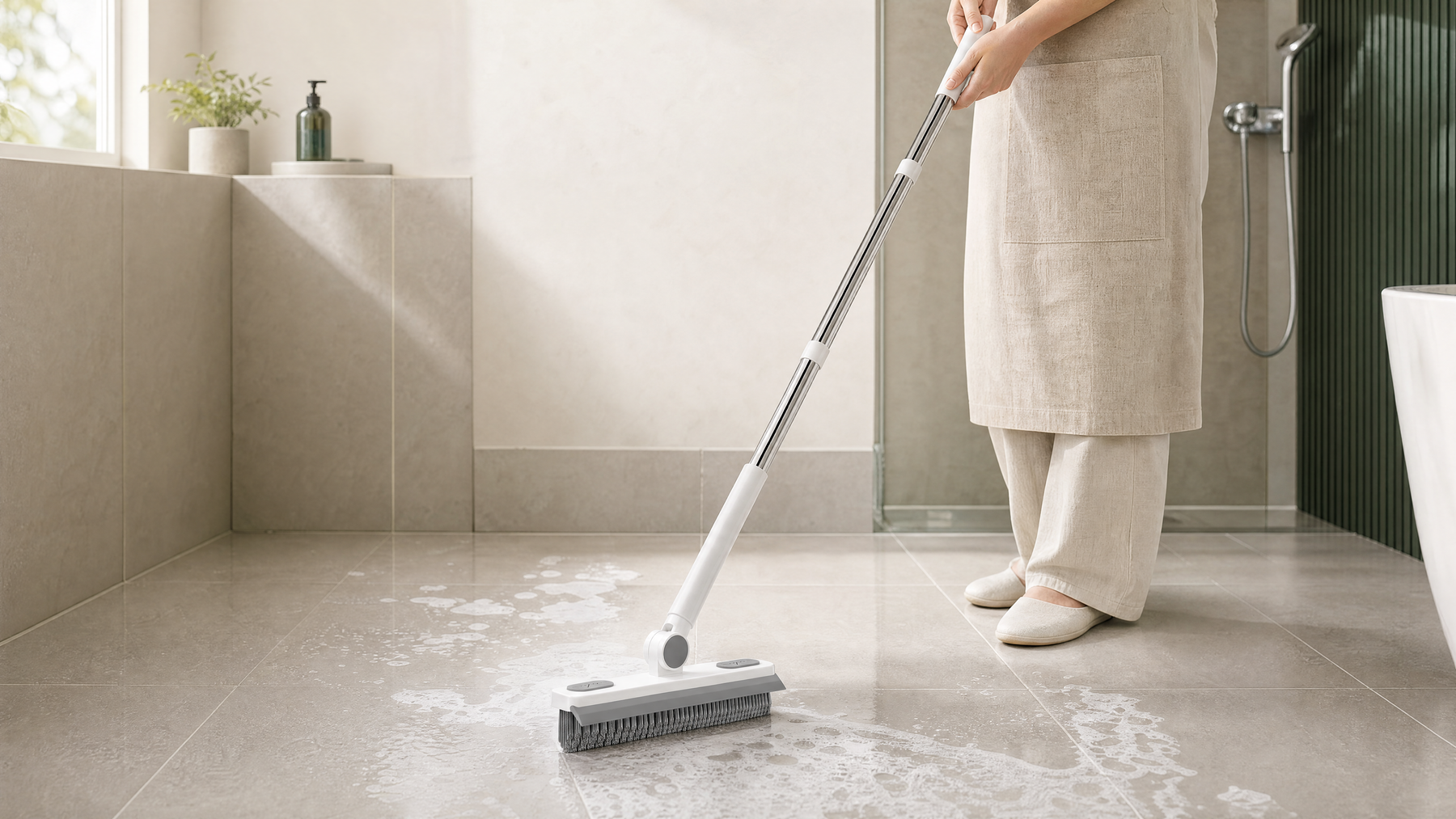
There is a spot in every home that has not been properly cleaned since the day you moved in.
You know exactly where it is. You are not avoiding the dirt — you are avoiding the position. Ten of those spots are below, each with the reason it defeats an ordinary brush and the specific thing about this one that changes the approach.
A household cleaning tool. Not a medical device, not a treatment for back pain, and not a substitute for advice from a healthcare professional.
It was never the scrubbing you were putting off
Ask anyone which household task they dislike and almost nobody says scrubbing. They describe a position: down on one knee on wet tile, one arm under a rim, head turned sideways, weight on a wrist. The unpleasant part is the getting there, and it repeats every eighteen inches. So the spots that need it most are the spots that get skipped.
Which low job bothers you most?
Pick the one you would happily never do again. You get the part of this page that deals with it, plus the honest limits.
The shower tray is textured, sloped and wet, so kneeling is uncomfortable and your weight lands on one wrist.
Extend to a mid length and work the tray from standing; the V tip tracks the perimeter seam.
See the tool →It will not resurface a stained tray or fix failed grout. Clean, not restore.
Which raises the obvious question: what exactly is it about a small brush that puts you on the floor in the first place?
An eight-inch brush decides where your body goes
A hand brush has exactly one requirement: your hand has to arrive at the dirt. Everything else follows. Shoulder drops, knee lands, spine curls. Add handle and the requirement moves — the bristles still have to arrive; your hand does not.
Drag from hand brush to full extension
Describes tool reach and the posture a length typically allows. It says nothing about force, effort or health outcomes.
If length is the lever, one fixed length is a strange thing to sell.
One fixed length is always the wrong length somewhere
Short handles give you pressure and precision and put you on the floor. Long handles keep you upright and take the pressure away. A shower stall wants one; a hallway of skirting wants the other. The pole locks at three published positions, so you set it to the job rather than living with an average.
Handle length selector
Compact / 26.5″
26.5″ / 67 cmCollapsed length. Close, controlled work where you want pressure and precision without a long lever.
- Shower tray and enclosure
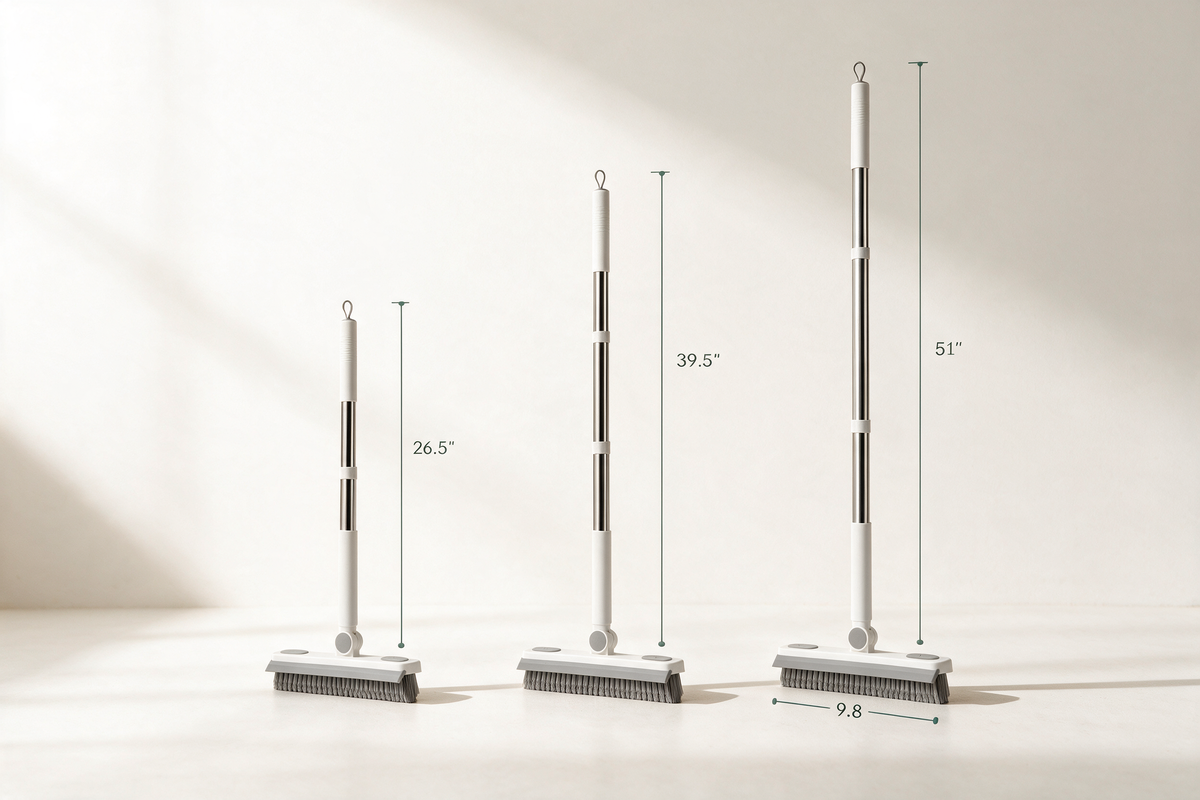
Lengths from the manufacturer's dimension drawing. Locking mechanism and load rating are not published; we would rather leave that blank than estimate it.
Length gets the head to the surface. It does not make the head lie flat once it arrives.
A head that turns is a head that can get in
Hold a rigid brush at arm's length and one edge of the bristles does all the work. The joint here swivels through a stated 180°, which is what lets the head go into a narrow gap lying flat, then turn to follow the shape it finds.
Turn the joint
Working angle
Roughly perpendicular: the everyday scrubbing position for floors and shower trays.
Abstract diagram, not a photograph. How firmly the joint holds an angle under load is on our open-questions list, not a claim we are making.
Getting the head into the gap is one problem. What the bristles do once they are in there is another.
Corners are lines, and a flat brush cannot follow a line
A square bristle block lands on both faces of a corner and misses the seam between them. Trim the bristles to a V and the tip leads into the join while the shoulders keep contact either side. Same stroke, one point of contact deeper.
Will it fit your gap?
The most common return reason in this category is a head wider than the space it was bought for. The head is 9.8 inches across. Measure yours, then move the slider.
At 12″ the 9.8″ head slides in with clearance. This is comfortable territory.
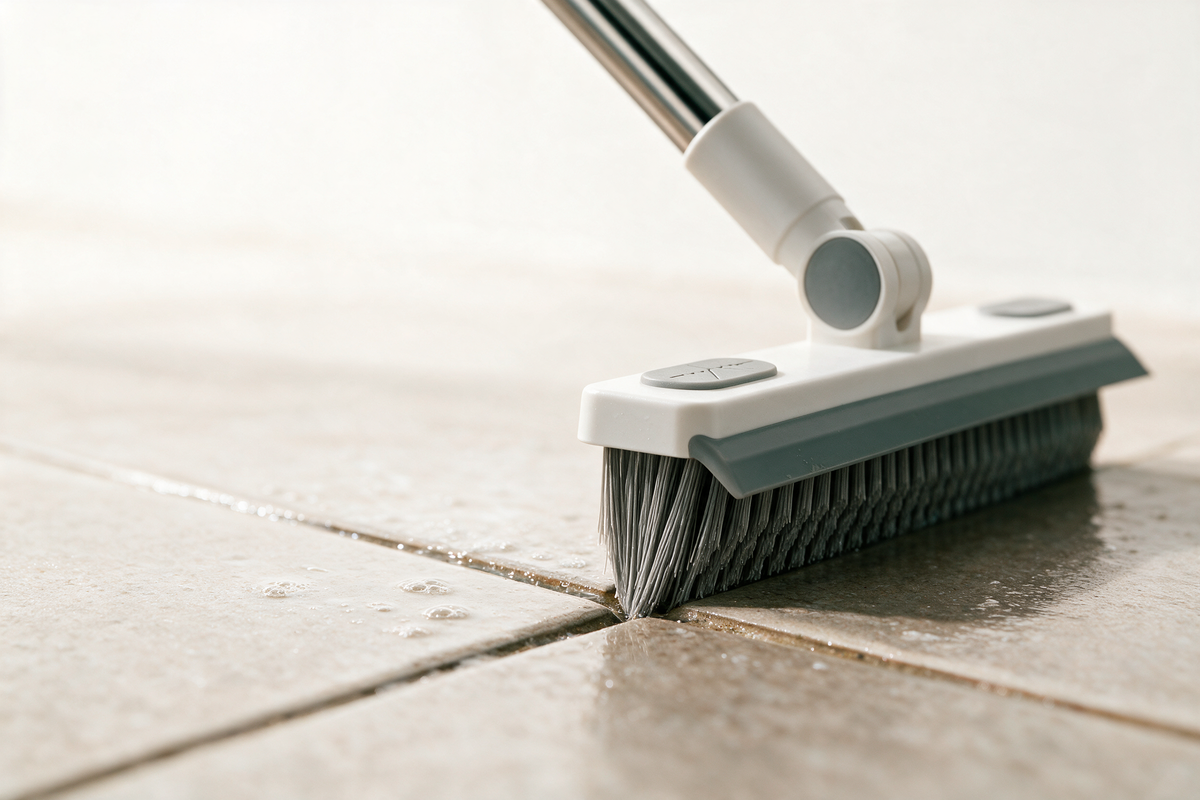
What the V is for
Grout lines, tile joins, wall-to-floor junctions and the channel where a shower tray meets the wall.
Where it is not the answer
Gaps narrower than the bristle tip, and grout that is already loose, cracked or unsealed. Repair first.
Head width 9.8″
Wide enough to cover a tile in one pass, narrow enough to work between a toilet and a wall in most bathrooms.
So that is length, angle and shape. The question is where in an ordinary home all three matter.
Every home has about eleven of these. Most get cleaned once a year
Each spot comes with what makes it awkward, which part of the tool applies, how to work it, and where to be careful. If a spot is not on this list, it probably is not a job for this brush.
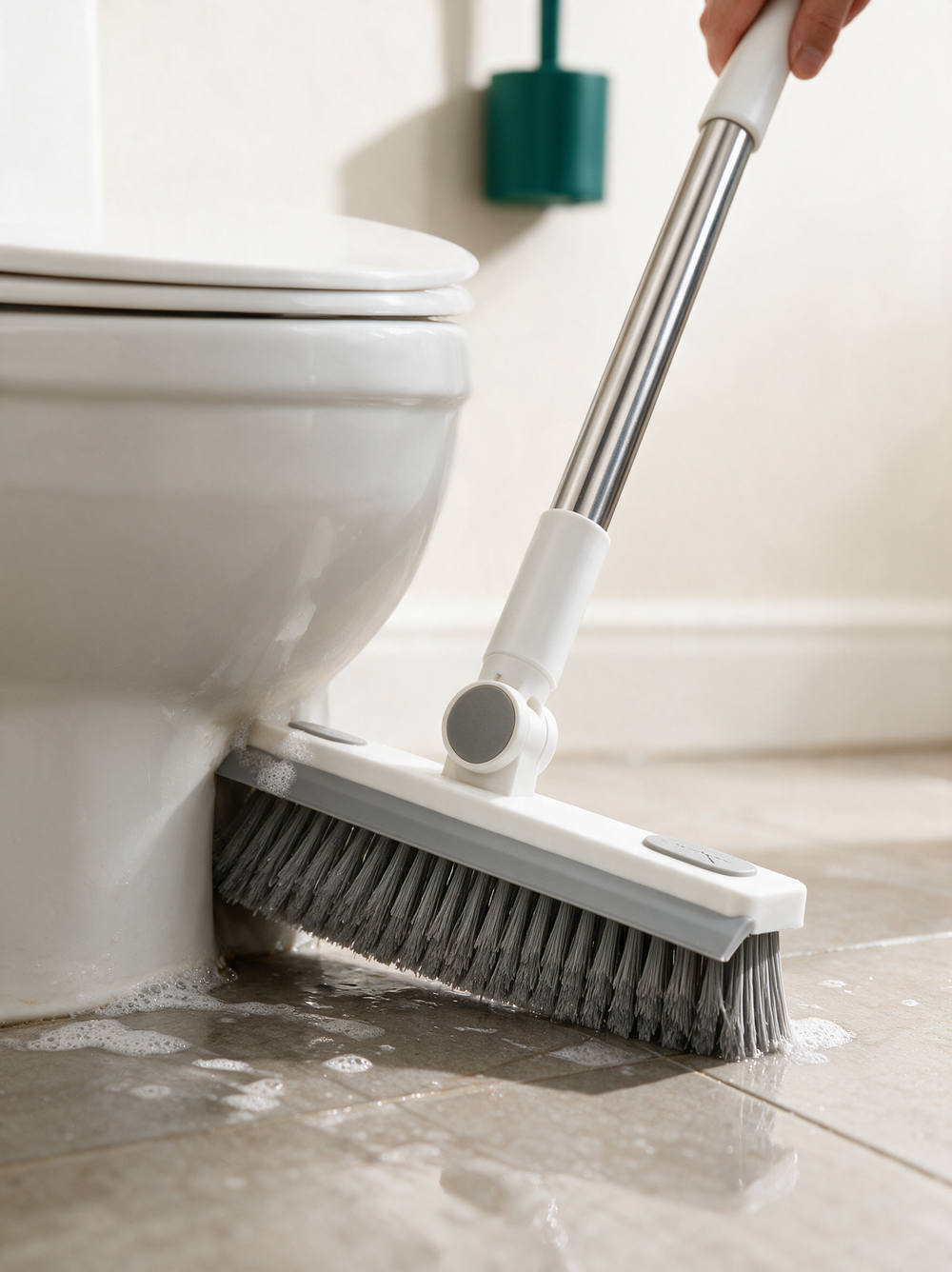
Caption: in use at the spot most people name first.
All of which you could attempt with something already in the cupboard. The honest question is what that would cost you.
Two working faces, one joint, and nothing to charge
Bristles agitate. What they do not do is move the loosened mess anywhere, which is why a scrubbed floor still dries streaked. The reverse of this head carries a flexible scraper strip, so you scrub, flip, and pull the water out in one pass.
What is in your cupboard right now?
Cheap, disposable and fine for a quick sink or a small spill.
Puts your hand and face right at the dirt; useless for reach.
A pole keeps the same scrubbing action at floor level while you stand.
Quick wipe-ups and tight detail work in the hand.
Five tools, one tiled bathroom floor
Rows describe what a category typically does, not what every product in it does.
| Hand brush | Flat mop | Electric | Sponge mop | Tidewell | |
|---|---|---|---|---|---|
| Reach without kneeling | No | Partial | Partial | Partial | Yes |
| Into corners and grout | Partial | No | Partial | No | Yes |
| Clears rinse water | No | Partial | No | Yes | Yes |
| Works on stairs and edges | Yes | No | Partial | No | Yes |
| No power or charging | Yes | Yes | No | Yes | Yes |
| Typical price band | $ | $$ | $$$ | $ | $$ |
Scroll sideways for the full table. Price bands reflect what the category sells for, not a promise about any product.
Eight things worth checking before you buy any long-handle brush
Search this category and you will find dozens of V-shaped brushes between five and thirty dollars. Tick these off against whatever you are considering, this one included.
Does the handle actually lock, or just friction-hold?
A real locking mechanism holds length under a scrubbing stroke; friction poles creep shorter.
Is the head width stated?
9.8″ here. If a listing will not tell you, assume it is guessing.
Does the head really rotate, and how far?
A stated 180° here. Watch for photos that imply rotation the joint does not have.
Are the bristles shaped for corners?
A V profile reaches seams a square block skips.
Is there a scraper as well as bristles?
Two faces clear water in one pass instead of leaving streaks.
What surfaces is it rated for?
Glazed tile and sealed grout here; test soft finishes first.
How does it store?
A hanging loop lets it drain and dry; damp storage is how tools smell.
What is not confirmed?
Material grade, weight, warranty and replacement heads are open here, stated plainly.
Handle and bristle material grades, product weight, replacement-head availability and warranty terms. We will publish each one here when it arrives in writing, rather than estimating it from photographs.
Longer is not automatically better, and four other things people get wrong
These come out of reading how people in this category describe their disappointments. Tap any card for what is actually going on.
Same clean, different set of movements
This is not a miracle and it will not make a dirty floor clean by itself. What it changes is the shape of the task: fewer transitions between standing and kneeling, fewer tool swaps, and one pass that finishes rather than three that nearly do.
- Kneeling on wet, cold tile
- Bracing a hand to reach behind fixtures
- Swapping between three different tools
- Trips back down for a spot you missed
- Wringing a mop over the same streak
- Cleaning from standing, in one pass
- Setting the length once and getting on
- Reaching the spots you used to skip
- Scrub and squeegee without switching tools
What it is for, what needs a light hand, and what to keep it away from
Guidance based on the head design and general surface-care practice. Always follow the care instructions for your own flooring and test in a spot nobody looks at first.
Ceramic tile
Bristles and scraper are intended for hard, glazed floor surfaces.
Porcelain tile
Including textured and anti-slip finishes.
Sealed grout
The V tip tracks along grout channels.
Sealed concrete
Common in laundries, garages and balconies.
Acrylic tub or shower
Acrylic scratches more easily than tile. Light pressure.
Natural stone
Finish and sealer vary widely; test first.
Vinyl and laminate
Wear layers are thin. Light pressure, keep water minimal.
Painted baseboards
Let the bristle tips do the work to avoid scuffs.
Hardwood
Wood finishes and standing water do not mix.
Six steps, then a note on working comfortably
Nothing here needs tools, batteries or instructions you have to keep.
Extend and lock
Pull the pole to the length the job needs and lock it before you start.
Wet the surface
A little water or your usual cleaner; follow that product label.
Scrub with the bristles
Let the V tip lead into corners and grout; short, steady strokes.
Flip to the scraper
Turn the head and pull water and residue toward a drain.
Rinse the head
Work out trapped hair and grit under the tap.
Hang to dry
Collapse to 26.5″ and hang by the loop so it drains.
Is it for you?
If you have low, textured or edge-heavy spots you keep skipping because reaching them means kneeling, this is built for exactly that. If your floors are large, flat and open, a mop still wins.
Six reasons not to buy this, answered properly
These are the objections that come up most. Two of them are fair.
Mini FAQ
Search it. If nothing matches, the answer is that we do not know yet.
Ten low spaces. One tool that gets to all of them from standing.
A pole that locks at 26.5, 39.5 or 51 inches. A joint that turns through 180°. A 9.8-inch head with bristles on one face and a scraper on the other. Everything above is just a description of what those three things let you stop doing.
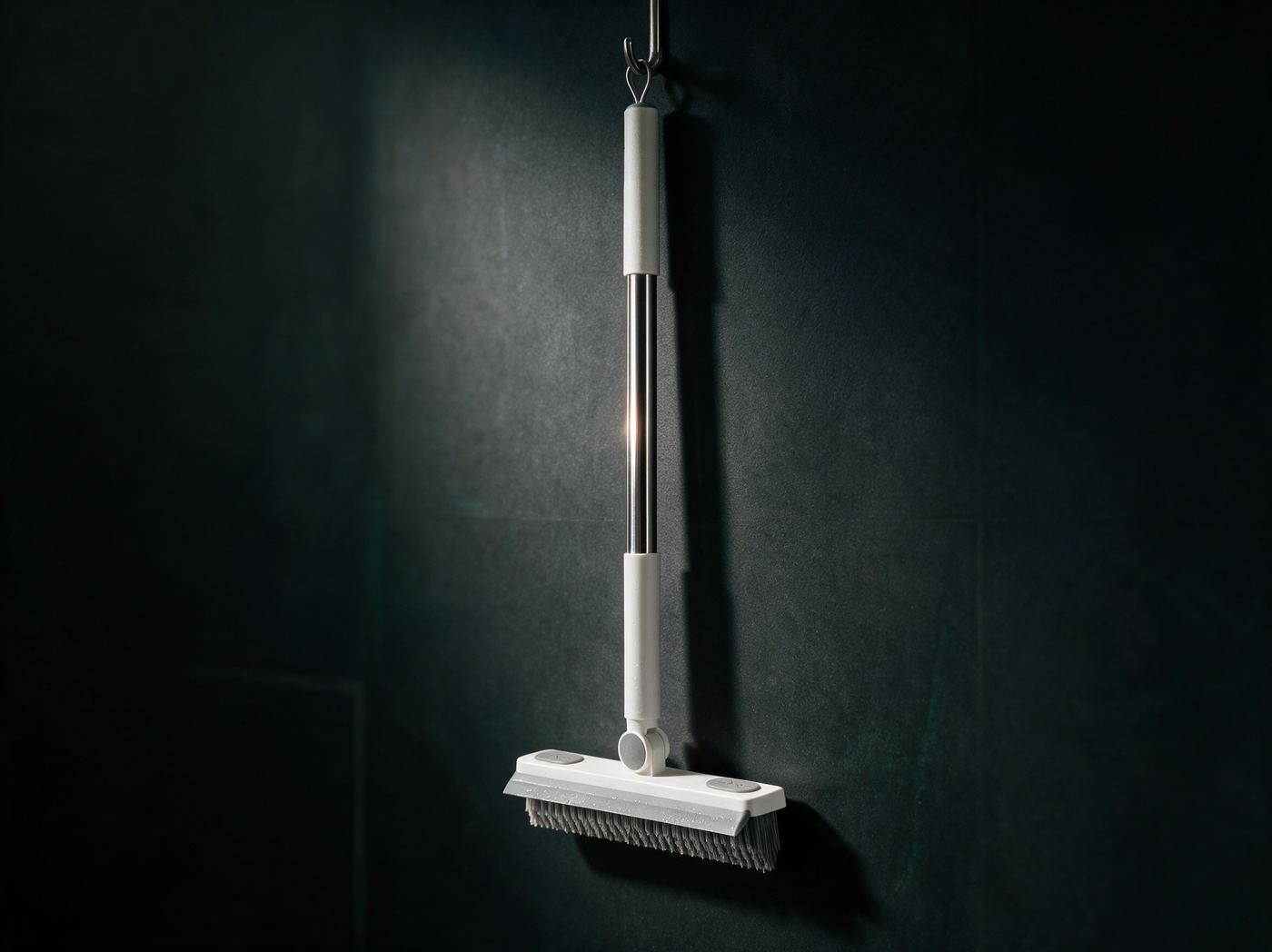
Caption: collapsed to 26.5″ and hanging by the loop, which is how it should be stored.