Your cart
Your cart is empty.
Nothing added yet.
10 Ways to Clean Low Spaces Without Folding Yourself in Half
The dirt is ordinary. The places it collects are not: floor edges, tile corners, the gap behind the toilet. Here are ten of them, and how to reach each one standing up.
The Tidewell adjustable crevice brush extends from 26.5 to 51 inches, so the bristles work at floor level while your hands stay near waist height. Same scrubbing, different posture.
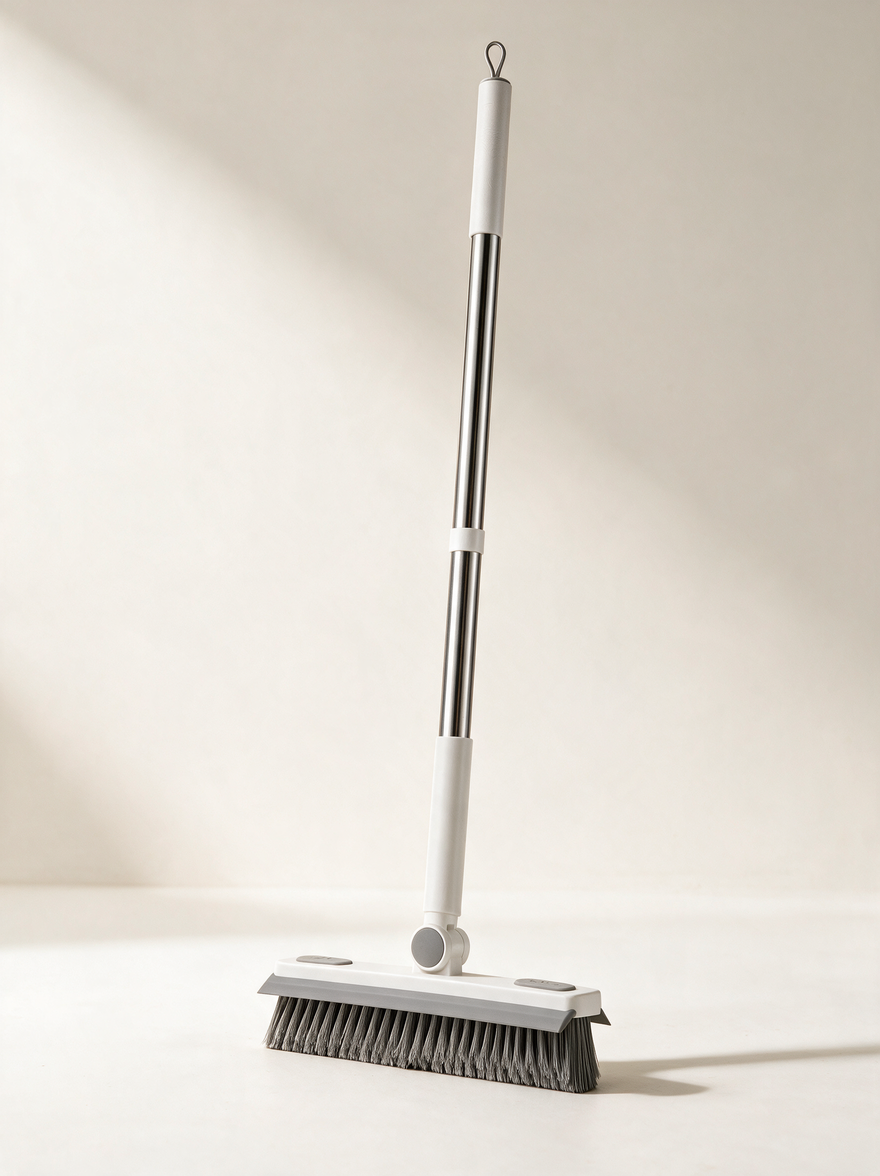
Nobody avoids cleaning the shower corner because they are lazy. They avoid it because getting to it means folding into a shape nobody enjoys, on a surface nobody wants to kneel on, with a brush the size of a bar of soap.
This is a plain look at ten low spaces that short tools make harder to reach than they need to be, and what changes when the handle adjusts, the head pivots and the bristles come to a point. Every measurement below is taken from the manufacturer’s own product drawings.
This is a cleaning tool, not a medical device. It is not a treatment for back pain. Persistent, severe or worsening pain should be assessed by a qualified healthcare professional.
Work out which jobs are actually putting you on the floor
How many times do you bend during one clean?
Interactive 01Pick the jobs you actually do. The counter uses your own assumptions to sketch how much bending, kneeling and repositioning a routine involves.
low-level movements: bending, kneeling or repositioning
at 2 clean(s) a week, over roughly four weeks
of those movements are for surfaces a long handle may let you reach from a more upright position
Illustrative estimate only, built from the assumptions you selected. Not a measurement, not a study, and not a prediction of comfort or health outcomes.
Put four feet between your face and the floor
Match the handle to the job, not to the room
Handle length explorer
Interactive 02Mid-length
39.5″ / 100 cmThe everyday setting. Long enough to work a floor standing slightly forward, short enough to steer accurately.
- Shower floors and tub edges
- General floor scrubbing across a room
- Working around fixtures and appliance kickboards
Let the bristle shape reach into the corner for you
Get behind the toilet without the balancing act
Scrub through a pole instead of down on your knees
Textured, sloped and wet: the least pleasant surface to kneel on, and the one that needs scrubbing most often.
Mostly edges and corners. A long handle lets you work the perimeter without shuffling on the tile.
Repetitive back-and-forth over a small area. Through a pole you use your body weight instead of your shoulder.
Reaching over a rim is awkward and unsupported. Extra length removes the need to lean in.
Wet floors are slippery. Keep stable footing, work in short strokes, and don’t lean past your balance. If a movement hurts, stop.
Let the head follow the surface instead of your wrist
Head angle simulator
Interactive 03Working angle
Roughly perpendicular: the everyday scrubbing position for floors and shower trays.
Diagram, not a photograph. The 180° figure is the manufacturer’s stated range.
Clear the water without a second trip down
Find the low spaces you have been quietly skipping
Where it works, room by room
Interactive 04Shower floor and tray
- The problem
- The perimeter seam collects soap film.
- Why usual tools struggle
- Hand brushes mean kneeling on a wet, sloping surface.
- Feature that applies
- Mid-length handle + V tip
- Technique
- Work the flat area, then run the V along the seam.
- Care note
- Test on acrylic/fibreglass first; gentle pressure.
Set the tool to your body before you start
Adjust once at the beginning rather than compensating with your posture for ten minutes.
Floors want more length; a tub rim or shower wall usually wants less so you keep control.
Shorter means more direct pressure. Longer means more reach and less precise force.
Take a small step instead of stretching. Overreaching on wet tile is how people lose balance.
No handle setting is right for everyone. Comfort depends on the person, the task and the surface, and none of the above is medical advice.
What changes when you stop folding in half
Not a miracle. A different set of movements for the same result.
- −Deep bending to reach floor edges
- −Kneeling on hard, wet surfaces
- −Crawling into corners to finish a line
- −Direct hand contact with the dirty area
- −Swapping between three different small brushes
- +Reach into low and narrow spaces
- +Controlled pressure through a pole
- +Continuous movement between surfaces
- +One tool that hangs up and dries
Surface compatibility
Interactive 05Guidance based on the head design and general surface care practice. Always follow the surface manufacturer’s care instructions and test in an inconspicuous area first.
Ceramic tile
Bristles and scraper are intended for hard, glazed floor surfaces.
Porcelain tile
Including textured and anti-slip finishes.
Grout (sound and sealed)
The V tip tracks along grout channels.
Sealed concrete
Common in laundries, garages and balconies.
Shower tray, textured
Work in overlapping passes; the seam is what the V tip is for.
Acrylic tub or shower
Acrylic scratches more easily than tile.
Fibreglass shower pan
Softer than porcelain. Light pressure.
Natural stone
Finish and sealer vary widely.
Vinyl and LVP
Wear layers are thin. Light pressure, no scraping.
Laminate
Keep water to a minimum and dry promptly.
Painted baseboards
Paint scuffs. Let the bristle tips do the work.
Silicone seals
Brush along the bead, never under it.
Glass shower panels
Use the scraper edge to clear water.
Hardwood
Wood finishes and standing water do not mix.
Loose or cracked grout
Repair first, then clean.
Polished marble
Asking the manufacturer about bristle hardness first.
How to use it
Six steps, then a note on working comfortably.
-
Join and lock
Push the pole into the head socket until it seats. No tools needed.
-
Choose a length
Set 26.5″, 39.5″ or 51″ based on the surface and how much force the job needs.
-
Set the head angle
Let the swivel find the surface. Flat for floors and under lips, turned over for vertical faces.
-
Test the surface
One light pass in an inconspicuous area before you commit, especially on stone, vinyl, acrylic or paint.
-
Scrub, then scrape
Apply a cleaner suited to the surface, work in overlapping strokes, then flip to the scraper to clear water and residue.
-
Rinse and hang
Rinse the bristles, clear trapped grit and hair, collapse the pole and hang it by the loop to dry.
Working comfortably
Choose a length that lets you reach without stooping or stretching
Take small steps to reposition instead of overreaching
Keep both feet planted, especially on wet floors
Avoid forceful twisting at the waist
Do not force the head into a gap narrower than it is
Take breaks during longer tasks
Stop if a movement causes or worsens pain
Follow the safety directions on any cleaning product you use
How it compares to what you already own
Category descriptions are typical, not universal — individual products vary. Some jobs are still better suited to another tool, and those are noted.
Hand scrub brush
Typical of the category
Fixed-handle deck brush
Typical of the category
Flat mop
Typical of the category
Electric spin scrubber
Typical of the category
Tidewell V-head brush
Verified specs only
This is likely useful for you if…
Not everyone needs a 51-inch brush. These are the situations it was designed around.
- Floor-level cleaning is uncomfortable or slow for you
- You would rather not kneel on tile, ever again
- You are taller than the people cleaning tools seem to be designed for
- You clean bathrooms often and the edges are the part you dread
- You want to keep your hands farther from the surface you are cleaning
- Your home has tiled showers, grout lines or textured floors
- You are looking for something practical for a parent or grandparent
Who should take extra care
Please read this part properly.
- Anyone with significant, unexplained or worsening pain — speak to a healthcare professional first
- Anyone with balance limitations, particularly on wet floors
- Anyone who has been given specific medical advice about lifting, bending or reaching
- Anyone working with strong chemicals: ventilate, wear gloves, follow the label
- Delicate flooring — test first, or use a tool made for that surface
- Children should not use this tool unsupervised
This cleaning tool is not a treatment for back pain and makes no medical claims. Persistent, severe or worsening pain should be assessed by a qualified healthcare professional.
What customers say
The seam where my shower tray meets the tile annoyed me for two years. Twenty seconds with the pointed bristles and it looked like new grout.
Kitchen grout was grey, now it is not. I did the whole floor standing up.
I am 71 and this lets me do the job without kneeling at all.
Full extension is genuinely long. I use the middle setting most of the time.
The swivel is the whole point. It goes in flat then turns to follow the base.
Did every skirting board in one go, walking rather than crawling.
Head is a touch wide for the gap beside my toilet. Still use it daily on the floor.
Scrub, flip, pull the water to the drain. No chalky streaks now.
6′4″. First scrub brush not built for someone a foot shorter.
Two dogs, textured entry tile. The bristles get the grit out of the grooves.
I clean six flats a week. It replaced two hand brushes and my knees have noticed.
The seam where my shower tray meets the tile annoyed me for two years. Twenty seconds with the pointed bristles and it looked like new grout.
Kitchen grout was grey, now it is not. I did the whole floor standing up.
I am 71 and this lets me do the job without kneeling at all.
Full extension is genuinely long. I use the middle setting most of the time.
The swivel is the whole point. It goes in flat then turns to follow the base.
Did every skirting board in one go, walking rather than crawling.
Head is a touch wide for the gap beside my toilet. Still use it daily on the floor.
Scrub, flip, pull the water to the drain. No chalky streaks now.
6′4″. First scrub brush not built for someone a foot shorter.
Two dogs, textured entry tile. The bristles get the grit out of the grooves.
I clean six flats a week. It replaced two hand brushes and my knees have noticed.
Snapped together in seconds. You steer the joint with the pole and it is fine.
Textured shower tray was the job I put off. Now it takes four minutes and I stay dry.
Grooved balcony tile full of dried silt. Wet, scrub, scrape to the drain. Done.
Bought it for the bathroom, ended up doing the whole kitchen. The V tip sits in the grout line.
Collapses small for the cupboard and the loop means it hangs to dry.
The strip under my kickboards fits under there flat.
My wife bought it because I could not reach the tub edge comfortably any more.
The silicone line around the bath is finally the same colour as the bath.
One tool instead of three and it does not need charging.
Bathroom floors and edges are the fastest part of the turnover clean now.
Door track and entry tile grooves. Grit comes straight out.
Snapped together in seconds. You steer the joint with the pole and it is fine.
Textured shower tray was the job I put off. Now it takes four minutes and I stay dry.
Grooved balcony tile full of dried silt. Wet, scrub, scrape to the drain. Done.
Bought it for the bathroom, ended up doing the whole kitchen. The V tip sits in the grout line.
Collapses small for the cupboard and the loop means it hangs to dry.
The strip under my kickboards fits under there flat.
My wife bought it because I could not reach the tub edge comfortably any more.
The silicone line around the bath is finally the same colour as the bath.
One tool instead of three and it does not need charging.
Bathroom floors and edges are the fastest part of the turnover clean now.
Door track and entry tile grooves. Grit comes straight out.
Reviews mentioning medical outcomes are not published, in line with our review policy.
Every question we get asked
Including the ones we can’t answer yet.
Ten low spaces, one tool that reaches them
One head that scrubs and scrapes, one joint that turns through 180°, one handle that locks at 26.5, 39.5 or 51 inches. Everything else on this page is just describing what those three things let you stop doing.
- Ships as a flat-packed pole and head; assembles by hand, no tools.
- Collapses to 26.5″ and hangs by the loop so it drains and dries.
- Handle and bristle materials, weight and warranty are still being confirmed in writing.
- Questions answered by a person: hello@tidewell.example